What Is Psoriasis Vulgaris?
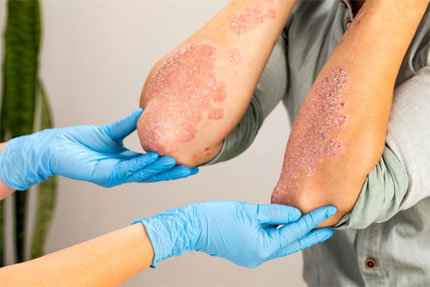
- Psoriasis vulgaris is the common form of psoriasis, also called plaque psoriasis.
- Typical psoriatic plaques are well-defined, raised, red or pink areas covered by dry, silvery-white scale. In darker skin, they may look brown or darker than surrounding skin.
- Common sites include elbows, knees, scalp and lower back, but psoriasis can occur almost anywhere.
- Some patients have only a few plaques; others develop extensive disease.
- Psoriasis can affect the nails and joints. Joint symptoms are important because psoriasis can be associated with psoriatic arthritis.
And no — it is not contagious: You cannot get psoriasis by touching, hugging, sharing food, swimming with or sitting next to someone who has it.
Schedule An Appointment Today
Our dedicated team is here to assist you. Reach out anytime—we’re ready to help!
Book Appointment
How Common Is Psoriasis?
- Worldwide: Psoriasis affects roughly 2–3% of the global population, although prevalence varies considerably between countries and populations.
- Age: It can begin at any age, with many patients developing it in young adulthood or later life.
- India: Indian studies report variation in prevalence and clinical patterns across regions and healthcare settings; psoriasis remains a common condition in dermatology practice.
- Course: Psoriasis usually follows a relapsing-remitting course, with periods of improvement followed by flares.
Why Does Psoriasis Happen?
Intrinsic factors — things inside the person
- Genetic tendency: Psoriasis often runs in families. Genes increase susceptibility but do not guarantee that a person will develop disease.
- Immune-system tendency: The immune system becomes overactive in pathways involving dendritic cells, T cells and cytokines such as TNF, IL-17 and IL-23.
- Biological factors: Age at onset, immune status and other biological factors can influence the pattern and severity.
- Associated conditions: Psoriasis is linked with psoriatic arthritis, obesity, hypertension, diabetes, abnormal cholesterol, fatty liver disease, inflammatory bowel disease, anxiety and depression.
Extrinsic factors — things around the person
- Skin injury: Cuts, scratches, burns, tattoos and other trauma can trigger psoriasis at the injured site — the Koebner phenomenon.
- Infections: Certain infections, especially streptococcal throat infection, can trigger psoriasis in susceptible people.
- Stress: A common patient-reported trigger and an important contributor to the stress–sleep–flare cycle.
- Smoking: Associated with higher psoriasis risk and potentially greater disease burden.
- Alcohol: Associated with psoriasis risk and may worsen disease in some people.
- Obesity and inactivity: Associated with psoriasis severity and can complicate treatment.
- Medicines: Lithium, some beta-blockers, antimalarials and withdrawal of systemic corticosteroids can worsen psoriasis in susceptible patients.
What Happens Inside the Skin?
- Healthy skin renews itself in an orderly way. In psoriasis, immune signals disturb this balance.
- Immune cells release inflammatory signals activating keratinocytes, and activated keratinocytes recruit and activate more immune cells, this creates a self reinforcing loop.
Why modern medicines work so well: Many newer treatments block a specific psoriasis signal such as TNF, IL-17 or IL-23 instead of broadly suppressing the entire immune system.
What Does Psoriasis Look and Feel Like?
- Raised, sharply defined plaques with scale.
- Commonly affects elbows, knees, scalp and lower back.
- Itching is common, but not everyone with psoriasis itches.
- Cracking can occur, especially on hands and feet.
- Scalp psoriasis can extend beyond the hairline and resemble severe dandruff.
- Nail psoriasis can cause pits, separation from the nail bed, thickening or yellow-brown discoloration.
- Genital and flexural psoriasis can be smoother and less scaly.
Schedule An Appointment Today
Our dedicated team is here to assist you. Reach out anytime—we’re ready to help!
Book Appointment
How Is Psoriasis Diagnosed?
- Usually clinical: An experienced dermatologist can usually diagnose plaque psoriasis from history and examination.
- Dermoscopy: May support diagnosis in selected cases.
- Skin biopsy: Not routinely required; considered when the appearance is unusual or a clinical mimic needs exclusion.
- Severity assessment: BSA, PASI, PGA and DLQI help measure disease burden and treatment response.
- Location matters: A small plaque on the face, hands, feet or genitals can be more disabling than its body-surface percentage suggests.
Investigations: What Tests Are Actually Needed?
- Straightforward psoriasis usually does not require blood tests just to confirm the diagnosis.
- Before systemic/biologic therapy: Tests are selected according to the proposed medicine and the patient's medical history.
- Common baseline checks: CBC, liver enzymes, kidney function and other medicine-specific tests.
- Methotrexate: Blood count, liver and kidney monitoring; alcohol and liver-risk assessment.
- Cyclosporine: Blood pressure and kidney function test.
- Acitretin: Liver tests and lipid profile are important; strict pregnancy-prevention.
- Biologics/targeted therapies: Latent tuberculosis and hepatitis screening before immunomodulatory treatment.
- Metabolic screening: Blood pressure, weight/BMI, glucose or HbA1c and lipid profile.
- Joint screening: Prolonged morning stiffness, swollen digits, heel pain and inflammatory back pain;
A useful rule: The goal of investigations is not to 'prove' psoriasis with a blood test. It is to choose treatment safely and identify important associated conditions.
How Is Severity Judged?
|
Measure
|
What it tells us
|
Why it matters
|
|
BSA
|
Percentage of body surface affected
|
Simple estimate of extent
|
|
PASI
|
Area, redness, thickness and scale
|
Tracks objective severity and response
|
|
PGA
|
Overall physician-rated severity
|
Quick clinic assessment
|
|
DLQI
|
Effect on daily life
|
Captures quality-of-life burden
|
Treatment: There Is No One-Size-Fits-All Plan
- Treatment depends on severity, location, symptoms, quality-of-life impact, previous therapy, other systemic illnesses, pregnancy plans, preference and access/cost.
- Modern care aims for clear or almost-clear skin and meaningful improvement in quality of life.
1. Topical Treatments
- Topical corticosteroids: Reduce inflammation, redness and scale.
- Vitamin D analogues: Calcipotriol/calcipotriene reduce abnormal epidermal growth and inflammation.
- Steroid + vitamin D combinations: Often effective because they combine complementary actions.
- Topical calcineurin inhibitors: Tacrolimus or pimecrolimus may be on face, folds and genital skin where steroid overuse is a concern.
- Keratolytics: Salicylic acid can soften thick scale and improve penetration of other treatments.
- Moisturizers: Reduce dryness, cracking and itch and improve comfort.
2. Phototherapy
- Narrowband UVB: Established treatment for widespread psoriasis, delivered repeatedly under medical supervision.
- 308-nm excimer laser: Targets psoriatic plaques while sparing much of the surrounding skin; useful for localized or resistant disease.
- PUVA: Effective in selected cases but used more selectively because of long-term safety considerations.
- Important: Phototherapy is controlled medical UV treatment — it is not the same as deliberate sunburn or tanning.
3. Conventional Systemic Medicines
- Methotrexate: Useful for moderate-to-severe psoriasis and psoriatic arthritis: laboratory monitoring is essential.
- Cyclosporine: Fast-acting option for selected severe/unstable psoriasis.
- Acitretin: Useful in selected patients, including some hyperkeratotic or pustular disease-palmer planter involvement ; strict reproductive precautions.
- Apremilast: Oral PDE-4 inhibitor for selected patients; gastrointestinal symptoms and weight changes can occur.
4. Biologic Treatments
- TNF inhibitors: Examples include adalimumab, etanercept, infliximab and certolizumab.
- IL-12/23 pathway:
- IL-17 pathway: Secukinumab, ixekizumab and brodalumab and bimekizumab.
- IL-23 pathway: Guselkumab, risankizumab, tildrakizumab and mirikizumab.
- Why they changed psoriasis care: Many patients achieve very high levels of skin clearance with targeted therapy. Choice depends on comorbidities, safety, cost, convenience and preference.
5. Targeted Oral Small Molecules
- Deucravacitinib: A selective TYK2 inhibitor.
- Why oral targeted therapy matters: Some patients prefer tablets over injections, while others prioritize maximum clearance, dosing frequency or a treatment suited to their joint or bowel disease.
Schedule An Appointment Today
Our dedicated team is here to assist you. Reach out anytime—we’re ready to help!
Book Appointment
Procedural & Device-Based Treatment
- 308-nm excimer laser: Useful for localized plaques, difficult sites or selected resistant lesions.
- NB-UVB: A medical phototherapy procedure for larger areas of psoriasis.
Diet: Can Food Make Psoriasis Better or Worse?
- Food is not the sole cause of psoriasis, and there is no single diet that cures it.
- Weight loss when overweight: Calorie-controlled weight reduction may improve psoriasis.
- Mediterranean-style eating: Vegetables, fruit, legumes, whole grains, nuts, fish and unsaturated fats support overall health.
- Omega-3 foods: Fish and omega-3-rich foods provide nutritional benefits.
- Gluten-free diet: Not routinely needed. Consider only when coeliac disease or relevant gluten sensitivity is present.
- Vitamin D: Supplement deficiency when indicated; taking high doses without a reason is not advisable.
- Ultra-processed foods: Reducing them can help weight and metabolic health.
- Practical message: Improve the overall quality of the diet rather than following long internet lists of forbidden foods.
Be careful with internet food lists: There is no strong evidence that every person with psoriasis must avoid tomatoes, dairy, sugar, gluten or 'nightshades'. Individual triggers can exist, but universal bans are not evidence-based.
Smoking and Psoriasis
- Smoking is associated with a higher risk of developing psoriasis.
- It may also be associated with more severe disease and poorer overall health.
- Tobacco-related inflammatory and oxidative pathways may contribute to immune activation.
- Smoking also increases cardiovascular risk, which matters because psoriasis patients may have higher cardio-metabolic risk.
- Smoking cessation is therefore part of good psoriasis care, not merely general health advice.
Alcohol and Psoriasis
- Alcohol and psoriasis can reinforce each other: psoriasis can affect mood, while alcohol may be used to cope with stress.
- A positive association exists between alcohol consumption and psoriasis.
- Heavy alcohol use can complicate treatment through liver risk and poor adherence.
- Reducing or avoiding alcohol is especially important with medicines that carry liver-related concerns.
- Individual responses differ; the goal is to avoid harmful or heavy use and recognise personal flare patterns.
Stress, Sleep and Lifestyle
- Stress is a common reported trigger.
- Poor sleep can worsen itch, stress and quality of life.
- Regular physical activity is encouraged, especially because obesity, diabetes and cardiovascular risk commonly accompany psoriasis.
- A realistic routine beats a perfect routine that lasts three days.
- Walking regularly, improving sleep, stopping smoking, reducing alcohol and choosing healthier meals can support medical treatment.
Psoriasis and Psoriatic Arthritis
- Psoriatic arthritis can cause permanent joint damage if diagnosis and treatment are delayed.
- We ask about joint pain, swelling, morning stiffness, heel pain, sausage-like swelling of fingers/toes and inflammatory back pain.
- Joint symptoms can appear before, after or alongside skin disease.
- Early rheumatology assessment is important when symptoms suggest psoriatic arthritis.
- Treatment choice can change when significant joint disease or inflammatory bowel disease is present.
Psoriasis and the Rest of the Body
- Important associated conditions: psoriatic arthritis, obesity, hypertension, diabetes, dyslipidaemia, metabolic syndrome, fatty liver disease, inflammatory bowel disease, anxiety and depression.
- Why screening matters: These conditions affect overall health and can influence thepsoriasis treatment.
- Mental health: Visible psoriasis can affect confidence, relationships, work and social life. Anxiety and depression deserve active attention.
Latest Advances in Psoriasis Treatment
- IL-17 and IL-23 inhibitors: These have transformed moderate-to-severe plaque psoriasis, allowing many patients to achieve very high levels of clearance.
- TYK2 inhibition: Deucravacitinib is an important oral targeted approach not available in India.
- Treat-to-target: Modern care uses measurable clearance and quality-of-life goals rather than accepting inadequate control indefinitely.
- Personalized selection: Dermatologists increasingly match treatment to joint disease, bowel disease, obesity, cardiovascular risk, infection risk, pregnancy plans and patient preference.
- Combination strategies: Targeted phototherapy can be useful for selected stubborn/localized lesions, including partial responses during systemic therapy.
Schedule An Appointment Today
Our dedicated team is here to assist you. Reach out anytime—we’re ready to help!
Book Appointment
Prognosis: What Can a Patient Expect?
- Psoriasis is a chronic diseaseand not a one-time infection that can simply be eliminated.
- Some patients have long periods of minimal disease; others experience frequent flares.
- Modern therapies can produce near-complete or complete clearance in many patients, but stopping treatment can allow psoriasis to return.
- Recurrence does not mean treatment was useless; it reflects the chronic nature of psoriasis.
- Early treatment is worthwhile when disease affects sleep, mood, work, relationships or joints.
- With appropriate treatment and follow-up, many people with psoriasis lead normal, active lives.
How We Manage Psoriasis at DermaStation: A Practical Approach
- Confirm the diagnosis.
- Map the disease — skin, scalp, nails, sensitive areas and joints.
- Measure severity using BSA/PASI/PGA and ask about quality of life.
- Identify triggers and lifestyle factors such as smoking, alcohol, stress, obesity, skin trauma and relevant medicines.
- Screen for important comorbidities and psoriatic arthritis.
- Choose treatment matched to disease severity and the patient's priorities.
- Set a clear treatment target and review whether it has been reached.
- If response is inadequate, check adherence and diagnosis, then adjust, combine or switch treatment as appropriate.
- Continue long-term prevention and follow-up.
When Should You See a Dermatologist?
- Persistent red, scaly patches that keep returning.
- Scalp scaling that does not improve with ordinary anti-dandruff treatment.
- Thick plaques on elbows, knees, back or other sites.
- Nail changes with skin lesions or unexplained persistent nail dystrophy.
- Skin disease associated with joint pain or prolonged morning stiffness.
- Psoriasis affecting the face, genitals, hands, feet or scalp.
- Rapidly spreading, painful, cracking or sleep-disrupting disease.
- Frequent flares despite treatment.
- Side effects from prolonged steroid or self-treatment.
What Patients Should Avoid
- Do not stop prescribed systemic or biologic treatment without discussing it with your dermatologist.
- Do not use potent steroid creams on the face, groin or folds without medical guidance.
- Do not aggressively scrub or scrape plaques; trauma can trigger more psoriasis.
- Do not rely on detoxes, miracle creams or restrictive diets instead of proven treatment.
- Do not use tanning beds as a substitute for supervised phototherapy.
- Do not ignore joint symptoms.
Frequently Asked Questions
Is psoriasis contagious?
No. Psoriasis cannot spread from one person to another.
Can psoriasis be cured permanently?
There is currently no guaranteed permanent cure, but modern treatment can often clear the skin almost completely and maintain excellent control.
Is psoriasis caused by poor hygiene?
No. Excessive washing and scrubbing do not cure psoriasis and can irritate the skin.
Can diet cure psoriasis?
No. A healthy diet supports treatment and overall health but should not replace medical therapy.
Should everyone with psoriasis stop gluten?
No. A gluten-free diet is mainly appropriate for selected patients with coeliac disease or relevant sensitivity.
Does alcohol worsen psoriasis?
It can, especially with heavier intake, and it can complicate some treatments.
Does smoking worsen psoriasis?
Smoking is associated with psoriasis risk and is an important modifiable health risk.
Are biologics safe?
They can be highly effective and are generally well studied, but they are not risk-free. Screening and monitoring are important.
Can psoriasis affect the joints?
Yes. Psoriatic arthritis is important to recognise early.
Can psoriasis occur on the face or genitals?
Yes. These areas often need gentler, site-specific treatment.
Medical Disclaimer
This page is for general education and website use. It is not a substitute for an in-person dermatology assessment. Treatment selection, drug dose, monitoring, phototherapy dose, biologic choice and duration depend on the individual patient. Approved indications and clinical recommendations vary by country and can change. The treating dermatologist should make the final decision using current local guidance and the patient's medical history.