What is vitiligo vulgaris?
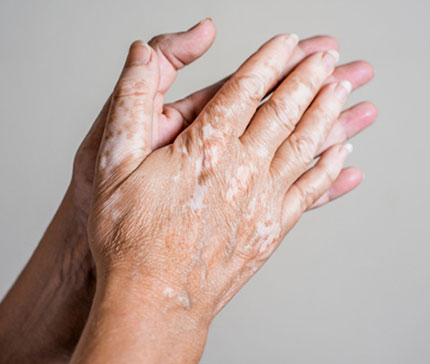
This is the most common type of vitiligo.
It usually causes white patches on both sides of the body.
Common areas include:
- Face
- Around the mouth or eyes
- Hands and fingers
- Arms
- Feet
- Armpits
- Groin
- Around the lips or genitals
How common is it?
- Vitiligo is fairly common.
- It can start at any age, but often begins in childhood or young adulthood.
- Men and women can both get it.
- It can affect all skin tones, but it is usually more noticeable in people with darker skin.
Why does vitiligo happen?
Vitiligo happens when the pigment-making cells of the skin, called melanocytes, stop working or are destroyed.
Internal causes
- Family tendency: It can run in families.
- Autoimmune tendency: In many people, the body’s immune system attacks its own pigment cells by mistake.
- Thyroid problems or other autoimmune conditions may be seen along with vitiligo in some patients.
External triggers
These may not directly cause vitiligo, but they can trigger it or make it spread in some people:
- Skin injury
- Repeated rubbing or friction
- Scratching
- Burns
- Sunburn
- Emotional stress
- Some chemical exposure
What happens inside the skin?
- The skin loses melanocytes, which are the cells that make colour.
- As a result, affected areas become white.
- Hair in those areas may also turn white.
- The skin usually feels completely normal, even though the colour changes.
Types of vitiligo
Non-segmental vitiligo
- The most common type.
- Patches often appear on both sides of the body.
- Vitiligo vulgaris comes under this group.
Segmental vitiligo
- Usually appears on one side of the body.
- Often starts earlier in life.
- May become stable faster.
Mixed vitiligo
- A combination of both patterns.
Schedule An Appointment Today
Our dedicated team is here to assist you. Reach out anytime—we’re ready to help!
Book Appointment
Symptoms patients notice
- Milky-white or light patches on the skin
- Slow increase in size of patches
- New patches appearing over time
- White hair in affected areas
- Colour loss on lips or inside the mouth in some patients
Is vitiligo harmful?
- Vitiligo is not life-threatening.
- It does not spread from person to person.
- It is not an infection.
- It is not skin cancer.
The main concern is usually cosmetic and emotional. Many people feel stressed, embarrassed, or less confident because of visible patches. This emotional effect is real and important, and it should be treated with care.
How is vitiligo diagnosed?
- In most cases, a dermatologist can diagnose it by examining the skin.
- A Wood’s lamp may be used to see the patches more clearly.
- Sometimes thyroid tests may be advised.
- A skin biopsy is usually not needed.
Treatment options
Treatment depends on:
- Age
- Type of vitiligo
- How active it is
- Which body parts are affected
- How much skin is involved
- How much it affects confidence and daily life
Medical treatment
Topical creams and ointments
These are often the first treatment for limited vitiligo.
- Steroid creams may help bring colour back in early or active patches.
- Tacrolimus or pimecrolimus may be used, especially on the face or in children.
- These medicines work best when used regularly under dermatologist guidance.
Oral medicines
These may be used in selected cases, especially when vitiligo is spreading quickly.
- Short courses of oral medicines may help slow the disease.
- They are not needed for every patient.
- They must be used only under medical supervision.
Procedural treatment
Narrowband UVB phototherapy
- One of the most useful treatments for widespread vitiligo.
- Uses a special medical light to stimulate repigmentation.
- Usually done two to three times a week.
- Best results are often seen on the face and trunk.
- Hands and feet usually respond more slowly.
Excimer light or laser
- Useful for small, limited patches.
- Good option for localized vitiligo.
Surgical treatment
This is considered only in stable vitiligo that has not changed for a long time.
Options may include:
- Skin grafting
- Melanocyte transfer
- Cell suspension procedures
These are usually chosen for selected patients and selected areas.
Role of JAK inhibitors
JAK inhibitors are one of the most important newer advances in vitiligo treatment.
What are they?
- These medicines target the immune signals involved in vitiligo.
- They help reduce the attack on pigment cells.
How are they used?
- Some are available as creams and FDA approved.
- Some oral JAK inhibitors are being studied and used in selected cases.
Why are they exciting?
- They offer a new treatment option, especially for patients who do not improve enough with older treatments.
- They may work even better when combined with light therapy in selected patients.
Latest advancements in vitiligo treatment
Treatment for vitiligo is improving steadily. Some important newer developments include:
- Better use of targeted light therapies
- Improved surgical techniques for stable vitiligo
- JAK inhibitor creams
- Ongoing research on oral JAK inhibitors
- Better understanding of how the immune system causes vitiligo
This means treatment is becoming more focused, more scientific, and more hopeful than before.
Role of diet
Diet alone does not cure vitiligo, but healthy eating supports overall skin and immune health.
Helpful advice
- Eat a balanced diet with fresh fruits and vegetables.
- Include enough protein.
- Correct vitamin deficiencies if present.
- Stay hydrated.
Schedule An Appointment Today
Our dedicated team is here to assist you. Reach out anytime—we’re ready to help!
Book Appointment
Important point
- There is no single “vitiligo diet” that works for everyone.
- Do not follow strict food restrictions unless advised for another medical reason.
- Supplements may help in some cases, but they are not the main treatment.
Prognosis
- Vitiligo is often a long-term condition.
- In some people it stays limited.
- In others it may slowly spread.
- Early treatment usually gives better results.
- Facial lesions often respond better than lesions on hands and feet.
- Stable vitiligo is easier to treat surgically.
- Some patients get very good improvement, while others need long-term maintenance.
Everyday care tips
- Use sunscreen regularly, especially on white patches.
- Avoid getting sunburn.
- Reduce friction from tight clothing or repeated rubbing.
- Do not self-medicate with strong creams.
- Use camouflage cosmetics if desired.
- Keep follow-up visits regular.
A reassuring note for patients
- Vitiligo is treatable.
- Improvement may take time, so patience is important.
- Treatment plans are different for each person.
- The goal may be to stop spread, bring colour back, or both.
- Support, reassurance, and proper medical guidance can make a big difference.
When should you see a dermatologist?
- If you notice new white patches
- If patches are spreading
- If hair in the patches is turning white
- If the condition is affecting your confidence
- If you want to start treatment early for better results
If you want, I can now turn this into a clean clinic-website version in Word format, with:
- simple headings,
- bullet points,
- SEO-friendly wording,
- and placeholders for non-copyrighted vitiligo images.